لطفا منتظر بمانید ...
0% Complete
صفحه اصلی
/
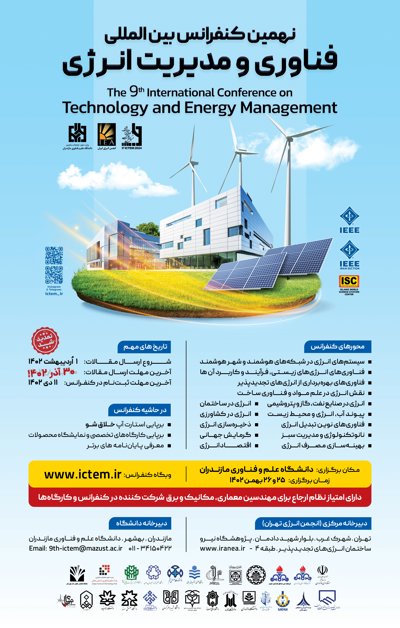
نهمین کنفرانس بین المللی فناوری و مدیریت انرژی
Assessing the GHG mitigation pathways in the Iran energy supply system
نویسندگان :
Mohammad Sharifian
1
Hossein Khajehpour
2
Amir Hossein Fakehi Khorasani
3
1- Sharif University of Technology
2- Sharif University of Technology
3- Institute for International Energy Studies
کلمات کلیدی :
Energy system model،Iran،Energy transformation pathways،OSeMOSYS،CO2 emission
چکیده :
The process of making decisions about energy and environment-related matters in Iran has consistently been intertwined with intricate difficulties. Discussing these complexities and the necessity to deal with them, this paper strives to help the decision makers with modeling of energy supply system. The main objective of this research is to propose optimal solutions for energy supply while reducing greenhouse gas emissions in line with the national upstream policies. If Iran wants to fulfill its commitments under an assumed national mitigation target, it needs to reduce its emissions by 30% by 2040. In this regard, the supply system modeling was performed under two scenarios, Business as Usual and Low-Carbon scenarios, with the OSeMOSYS tool. The research results in the Low-Carbon scenario suggest that the capacities of wind power plants, thermal solar power plants, and photovoltaic power plants need to increase to 10, 10.59, and 55.63 GW by 2040, respectively. Also in this scenario, electricity exports will decrease if the efficiency of fossil fuel power plants does not change.
لیست مقالات
لیست مقالات بایگانی شده
Useful Application of Machine learning Methods in Smart Grids: A Mini Review
Pooya Parvizi - Alireza Mohamadi amidi - Milad Jalilian - Hana Parvizi
Multi-Objective Coordinated Optimal Allocation of Distributed Generation and D-STATCOM in Electrical Distribution Networks Using Ebola Optimization Search Algorithm
Peyman Zare - Iraj Faraji Davoudkhani - Reza Mohajeri - Rasoul Zare - Hossein Ghadimi - Mehdi Ebtehaj
Analyzing energy consumption, IAQ, and thermal comfort conditions under three different strategies of personalized ventilation
Roya Rateghi - Mahdi Afzalian - Seyed Alireza Zolfaghari
Optimal Energy Management in the Electric Vehicles Parking Lot Equipped with Renewable Energy Source
Mohammad Hadian-Abbasalikashi - Meisam Jafari-Nokandi
Studying the Implementation of the Smartening Road Map of Iran's Electricity Distribution Network
Peyman Zare - Rasoul Zare - Hossein Ghadimi - Bakhshali Sabery - Iraj Faraji Davoudkhani - Ahad Babaei Bork Abad
A new model for calculating the cost of operation for different types of energy distribution systems in a comparative way
Mohammad TaghiTahooneh - Aidin Shaghaghi - Mohammad Yahyaeifar - Reza Dashti - Sahand Heidary - Rahim Zahedi
Utilizing fuzzy logic to optimize the extraction of maximum output power from the turbine
Seyyed Amirreza Abdollahi - Jafar Keighobadi - Seyyed Faramarz Ranjbar
A Review of Renewable Energy Technologies from Economic and Energy Perspective
Sayyad Nojavan - Amir Hossein Esmaeili
Building-Level Multi-Energy Load Forecasting: A Graph Representation Learning Convolution-Based Approach in Smart Meter-Enabled Environments
Mir Karim Aboutalebi Zonouz - Mehrdad Tarafdar Hagh - Sajad Najafi Ravadanegh
A Hybrid CNN-LSTM Approach Utilizing SCADA Data Enhancing Wind Power Predictions: A Dataset Case Study of Turkey
Hamed Kheirandish Gharehbagh - Ashkan Safari - Kazem Zare - Amir Aminzadeh Ghavifekr
بیشتر
ثمین همایش، سامانه مدیریت کنفرانس ها و جشنواره ها - نگارش 44.8.1